7 Questions to Ask When Touring a Preschool in Oviedo

Choosing a preschool is one of those parenting decisions that can look simple at first.
You search online, read a few reviews, look at photos, compare locations, and schedule some tours.
Then you walk into a preschool and realize there is a lot more to consider.
Are the teachers warm and engaged? What does a normal day actually look like? How does the school handle safety? What happens when your child is upset? Are meals provided? How often do teachers change? And how can you tell whether children are genuinely learning rather than simply staying busy?
That's why preparing a few questions to ask when touring a preschool can make such a difference.
A preschool tour isn't only an opportunity for the school to show you its classrooms. It's your opportunity to observe, ask questions, compare programs, and understand what your child's everyday experience might actually be like.
The U.S. Department of Health and Human Services' ChildCare.gov guidance for choosing quality child care encourages families to visit programs, ask questions, and consider factors including health and safety, teacher qualifications, learning environments, and relationships with caregivers.
For Oviedo families actively comparing schools, here are seven questions worth bringing to every tour.
1. “How Long Have Your Teachers Been Here, and Who Will Care for My Child?”
Parents often begin a preschool tour by asking about curriculum.
But there's another question worth asking early:
Who will actually spend the day with my child?
Young children build relationships through repeated interactions.
They learn who comforts them when they're upset.
Who helps them open their lunch.
Who listens to their stories.
Who recognizes when they're tired.
Who celebrates when they finally accomplish something they've been practicing.
That's why teacher consistency deserves attention.
The Harvard Center on the Developing Child explains the importance of responsive relationships between young children and caring adults. Back-and-forth interactions, sometimes described as “serve and return,” help support children's developing brain architecture and social and communication skills.
During your preschool tour, ask:
How long have the teachers been working here?
Who would be my child's primary teacher?
How do you support new children during the transition into preschool?
What happens when a teacher is absent?
How do teachers get to know each child's personality and needs?
Then observe.
Do teachers know children's names?
Do children voluntarily approach them?
Are teachers talking with children rather than only giving instructions?
When a child needs help, does the adult respond patiently?
These observations can tell you things that staff biographies cannot.
Why Teacher Turnover Matters
High turnover can mean children repeatedly have to adjust to new caregivers. It can also make consistent communication between families and teachers more difficult.
That doesn't mean a school must have exactly the same staff forever. People change jobs.
Instead, you're looking for evidence of stability and healthy relationships.
Kids Language Academy's family-owned environment and low staff turnover are therefore meaningful qualities for parents to consider not simply as business facts, but because consistency can influence a child's everyday preschool experience.
2. “What Does a Typical Day Look Like, and What Are Children Learning?”
A preschool can use impressive words such as:
- “Academic.”
- “Developmental.”
- “Enrichment.”
- “School readiness.”
- “Hands-on.”
- “Whole child.”
But what do those terms look like at 10:30 on a Tuesday morning?
Ask the school to walk you through a typical day.
Find out when children:
Play.
Eat.
Rest.
Read.
Go outside.
Participate in teacher-guided activities.
Create art.
Use music and movement.
Interact with classmates.
Choose their own activities.
Then ask:
“What are children learning during these experiences?”
This is an especially useful question because high-quality early learning isn't limited to worksheets or children sitting quietly at tables.
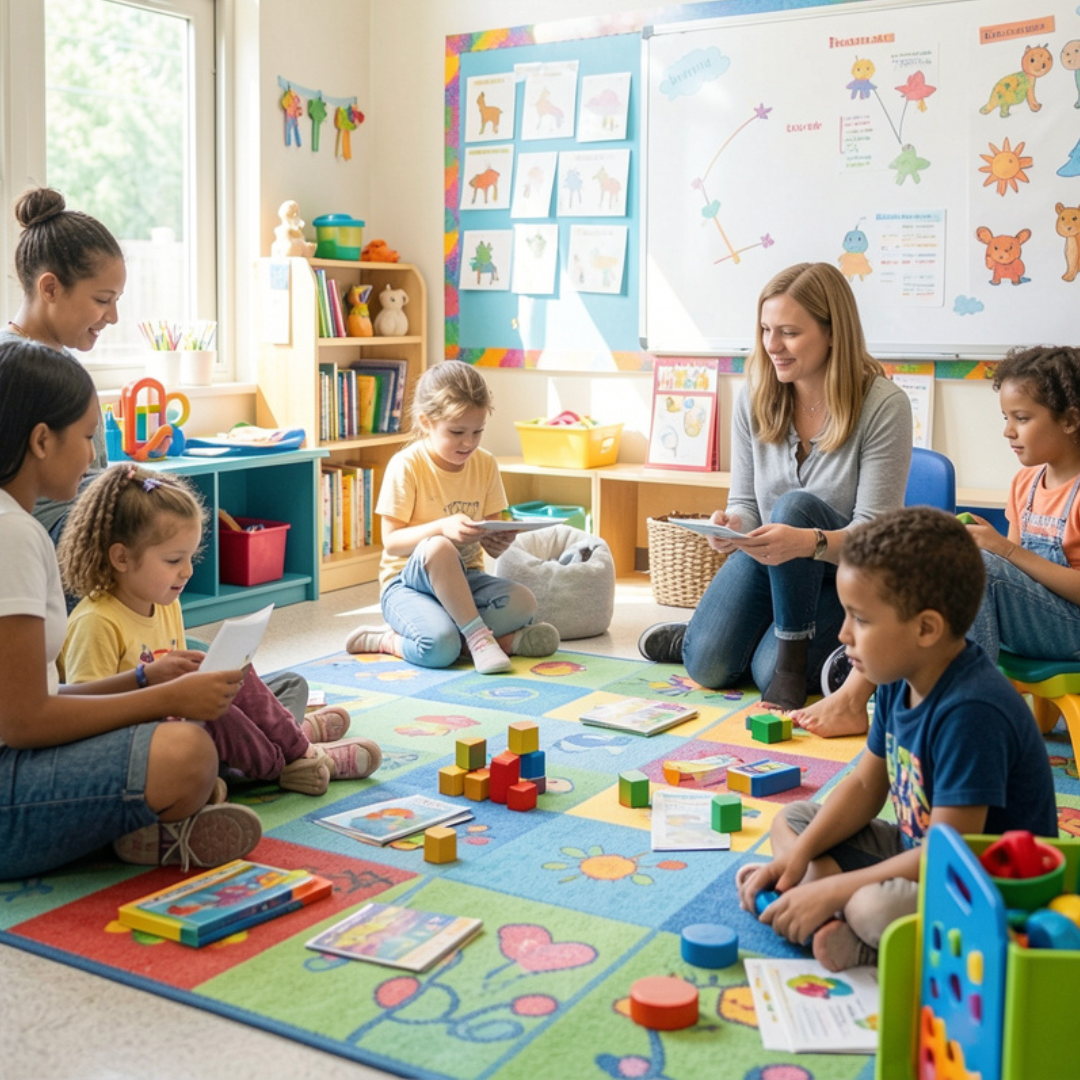
Imagine four children building a structure with blocks.
It may look like play.
But those children might also be practicing:
- Problem-solving.
- Planning.
- Fine motor skills.
- Spatial concepts.
- Communication.
- Turn-taking.
- Cooperation.
- Persistence.
- Vocabulary.
NAEYC describes developmentally appropriate practice as an approach that promotes children's optimal development and learning through strengths-based, play-based, joyful, engaged learning.
So don't judge a preschool solely by how “academic” the room appears.
Instead, ask whether activities are intentional and appropriate for young children.
What to Observe
During your tour, look at the children.
Are they curious?
Are they allowed to explore?
Are teachers asking questions?
Are children talking with one another?
Is there time for movement?
Do you see books, blocks, art materials, pretend play, and hands-on activities?
A useful preschool tour checklist should focus not only on what the classroom contains, but on what children are actually doing with it.
3. “How Do You Keep Children Safe, and How Will You Communicate With Me?”
Safety deserves more than a quick glance at the front door.
Parents should understand how the school handles safety throughout the entire day.
Ask:
How is the building secured?
Who can enter?
Who is authorized to pick up my child?
How are children accounted for during transitions?
How is outdoor play supervised?
What happens during an emergency?
What are your illness policies?
How are allergies and medications handled?
What training do teachers receive?
You can also ask about licensing and inspection information.
ChildCare.gov recommends that parents research childcare licensing requirements and inspection reports when evaluating programs.
But physical safety is only part of the conversation.
You also need to know:
How will the school communicate with you?
Ask:
- Will I receive information about meals and naps?
- How will I hear about injuries or incidents?
- How do teachers share developmental progress?
- Who should I contact with concerns?
- How often do families receive classroom updates?
Communication is especially important with young children because they may not be able to explain everything that happened during their day.
A three-year-old might tell you:
- “We painted.”
- That's useful.
- But parents may also want to know whether their child ate lunch, rested, struggled with separation, made a new friend, or showed progress with a skill.
- You should leave your tour understanding how the preschool plans to keep you informed.
4. “What Meals and Snacks Will My Child Eat?”
This question can easily get pushed to the bottom of a parent's list.
It shouldn't.
If your child attends full-time preschool, food becomes part of their daily school experience.
Ask:
Are meals included?
Are they prepared on-site or brought in?
Can I see a sample menu?
What kinds of snacks are offered?
How are food allergies handled?
What happens if my child is a selective eater?
Do families need to send food?
Why does this matter?
The USDA's MyPlate guidance for preschoolers explains that children ages 2 to 5 are developing eating habits and encourages offering a variety of fruits, vegetables, grains, protein foods, and dairy or fortified soy alternatives.
Meals can also support development beyond nutrition.
Think about what happens when young children eat together.
They practice:
- Using utensils.
- Waiting.
- Communicating needs.
- Trying new foods.
- Following routines.
- Cleaning up.
- Developing independence.
- Talking with teachers and friends.
In a bilingual environment, meals can even become another natural context for language.
Kids Language Academy provides fresh homemade meals, which can be an important practical consideration for families comparing childcare in Oviedo, FL.
For busy parents, having meals provided can also remove one task from the morning routine.
5. “How Does Your Program Balance Learning and Play?”
Parents naturally want their children prepared for kindergarten.
But school readiness doesn't mean turning preschool into elementary school early.
Young children learn through interaction and experience.
They build language by talking and listening.
They develop problem-solving by experimenting.
They learn social skills by playing with other children.
They strengthen their bodies through movement.
They develop imagination through pretend play.
They learn persistence when the block tower falls down and they decide to build it again.
The American Academy of Pediatrics explains that play supports children's development, including language, social-emotional, cognitive, and self-regulation skills.
So ask:
“How much time do children have for free play?”
“What does teacher-guided learning look like?”
“How do you introduce early literacy and math?”
“How often do children go outside?”
“How do teachers extend learning during play?”
Suppose a child is pretending to run a grocery store.
A skilled teacher can introduce:
- Numbers.
- Counting.
- Food vocabulary.
- Social phrases.
- Sorting.
- Colors.
- Questions.
- Turn-taking.
- The child is still playing.
- But learning is happening inside the experience.
When considering what to look for in a preschool, don't ask whether children play or learn.
Look for an environment where they can learn through play.
6. “What Learning Opportunities Does My Child Receive Beyond a Traditional Preschool Curriculum?”
This question helps parents understand what makes one program different from another.
Some schools may offer:
- Music.
- Art.
- STEM activities.
- Nature exploration.
- Physical education.
- Language enrichment.
- Cultural learning.
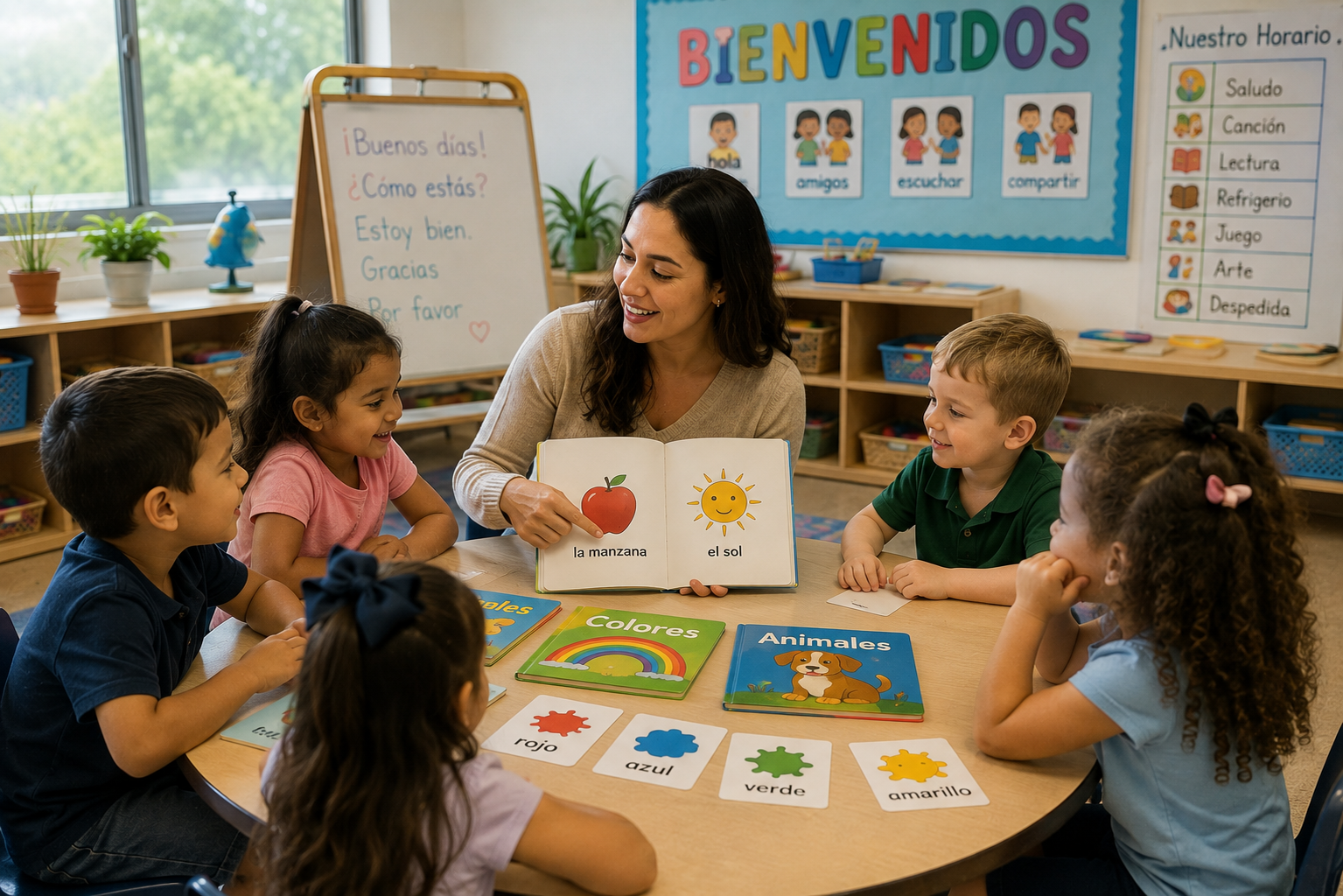
At a bilingual preschool in Oviedo, FL, you'll want to ask specifically how the second language is incorporated.
Ask:
“How often will my child experience Spanish?”
“Is Spanish taught as a separate lesson or used throughout the day?”
“What happens if my child doesn't understand Spanish yet?”
“How do you incorporate Spanish into play?”
“Do you use songs, stories, conversations, and routines?”
“How do you introduce Spanish-speaking cultures?”
This distinction matters.
Learning ten Spanish vocabulary words isn't necessarily the same experience as hearing and using Spanish naturally throughout daily activities.
NAEYC provides professional resources for supporting dual language learners, emphasizing intentional practices that support children's additional-language development while respecting their home languages.
At Kids Language Academy, the Spanish Immersion Program (SIP) is a central part of the early-learning experience.
Spanish can become part of:
- Songs.
- Stories.
- Play.
- Counting.
- Classroom conversations.
- Art.
- Routines.
- Everyday interactions.
For parents interested in a Spanish immersion preschool in Oviedo, that's an important distinction to explore during a tour.
What If We Don't Speak Spanish at Home?
Ask this too.
A quality program should be able to explain how it supports children who are completely new to Spanish.
Children may rely initially on:
- Gestures.
- Pictures.
- Repetition.
- Teacher modeling.
- Facial expressions.
- Familiar routines.
- Context.
They don't necessarily need to understand or speak everything immediately.
The goal should be meaningful exposure not pressure.
7. “How Will This Preschool Support My Child as an Individual and Does It Work for Our Family?”
This final question actually has two sides.
First:
Will my child be known as an individual?
Children don't all enter preschool with the same personality.
One child walks into a classroom and immediately joins a group.
Another watches quietly for twenty minutes.
One loves messy art.
Another dislikes getting paint on their fingers.
One talks constantly.
Another needs time before speaking in a new environment.
Ask:
“How do teachers learn about my child's interests and personality?”
“How do you help shy children adjust?”
“What if my child becomes frustrated?”
“How do you communicate developmental concerns?”
“How do you adapt activities for different needs?”
A preschool should have expectations and routines without treating every child as identical.
Then consider the second side:
Does the school work for your actual family?
The perfect educational philosophy doesn't help much if pickup is impossible with your work schedule.
Ask about:
- Opening time.
- Closing time.
- Holiday closures.
- Late pickup.
- Enrollment requirements.
- Tuition.
- Registration fees.
- What's included.
- Financial assistance.
Kids Language Academy is open Monday through Friday from 6:45 AM to 6:30 PM, offering extended hours that can be particularly helpful for working Oviedo families.
KLA also accepts School Readiness, which may be important for eligible families considering the affordability of care.
Practical questions aren't less important than educational ones.
Your preschool becomes part of your family's everyday routine.
The right program needs to work for both your child and your household.
Don't Just Ask Questions—Watch What Happens Around You
Here's one of the most useful preschool-tour tips:
Sometimes the answer isn't what someone tells you. It's what you observe.
You can ask whether teachers are caring.
But watch how they respond when a child starts crying.
You can ask whether children learn through play.
But look at what they're actually doing.
You can ask whether classrooms are welcoming.
But notice whether children seem comfortable approaching adults.
You can ask about cleanliness.
But look at the bathrooms, eating spaces, toys, and floors.
You can ask about communication.
But notice how staff greet parents arriving or leaving.
Your senses are part of your preschool tour checklist.
Listen.
Watch.
Ask.
And don't feel rushed.
You're gathering information about a place where your child may spend a significant part of their week.
A Quick Preschool Tour Checklist for Oviedo Parents
Before leaving each school, make sure you can answer these seven questions:
1. TEACHERS & CONSISTENCY
Who will care for my child, and how stable is the teaching team?
2. DAILY ROUTINE & CURRICULUM
What will my child actually do and learn throughout the day?
3. SAFETY & COMMUNICATION
How will the school protect my child and keep me informed?
4. MEALS & NUTRITION
What will my child eat, and how are allergies or dietary needs handled?
5. PLAY & LEARNING
Does the program provide meaningful opportunities for hands-on learning, movement, and exploration?
6. ENRICHMENT
What experiences does my child receive beyond a traditional preschool curriculum?
7. INDIVIDUAL & FAMILY FIT
Will teachers understand my child, and will the schedule, cost, and policies realistically work for our family?
After your tour, write down your impressions.
Don't assume you'll remember everything after visiting three or four schools.
Green Flags Worth Noticing
As you're learning how to choose a preschool, watch for positive signs such as:
- Teachers speaking warmly and respectfully with children
- Children comfortably approaching teachers
- Staff answering questions clearly
- A predictable but flexible daily routine
- Hands-on, age-appropriate learning
- Plenty of opportunities for play and movement
- Clear safety procedures
- Transparent communication
- Clear information about meals, schedules, and tuition
- Teachers who can explain why activities support development
- Respect for children's individual personalities and backgrounds
If you're evaluating bilingual programs, add:
- A clear explanation of what Spanish immersion actually looks like.
- Red Flags That Deserve Follow-Up Questions
No preschool will look perfect every second of the day.
A child might be crying.
A toy might be on the floor.
A teacher might be helping with a difficult transition.
One moment shouldn't automatically determine your decision.
But some observations deserve additional questions.
For example:
- Staff can't clearly explain the curriculum.
- Teachers frequently appear disengaged.
- Safety procedures are vague.
- Policies aren't available or clearly explained.
- Children spend most of the visit passively completing worksheets.
- Staff can't explain what “bilingual” or “immersion” means.
- The program promises unrealistic results such as guaranteed fluency within a short period.
- Questions about fees receive unclear answers.
- You're discouraged from asking about classroom practices.
- If something concerns you, ask.
- A good preschool should understand why parents want information.
Why Comparing Preschools Is Worth the Time
Parents sometimes feel pressure to make a quick choice, especially when enrollment spots are limited.
But comparing programs can help you understand what actually matters to your family.
Maybe you thought the biggest factor would be curriculum but discovered teacher stability matters more.
Maybe you assumed you'd pack lunch every day and then realized how helpful provided meals could be.
Maybe you weren't considering bilingual education until you saw Spanish used naturally during play.
Maybe extended hours become essential once you calculate your commute.
Every tour teaches you something.
That's why ChildCare.gov recommends visiting multiple childcare programs and comparing what you learn before making your decision.
Don't look only for the preschool with the longest list of features.
Look for the environment where those features create a strong everyday experience for your child.
Touring Kids Language Academy in Oviedo
For families researching a preschool in Oviedo, FL, Kids Language Academy offers several of the qualities worth exploring during a tour.
KLA provides a family-owned environment with low staff turnover, giving families an opportunity to build relationships with a more consistent team.
Its Spanish Immersion Program (SIP) introduces another language through everyday early-learning experiences rather than treating Spanish simply as a vocabulary list.
Children also receive fresh homemade meals, and the school offers extended weekday hours from 6:45 AM to 6:30 PM.
Kids Language Academy accepts School Readiness and serves infants, toddlers, preschool and Pre-K children, as well as school-aged children.
But don't choose KLA or any preschool based only on a list you read online.
Come see it.
Bring your questions.
Observe the classrooms.
Meet the teachers.
Ask about Spanish.
Ask about meals.
Ask about routines.
Ask about your child's specific needs.
That's what a preschool tour is for.
Bring These 7 Questions to Your Next Preschool Tour
Choosing a preschool doesn't require finding a place that looks perfect.
It requires gathering enough information to make a thoughtful decision.
Remember these seven questions:
Who will care for my child, and how consistent is the teaching team?
What does a typical day look like?
How do you handle safety and parent communication?
What meals and snacks will my child receive?
How do you balance learning and play?
What learning opportunities are available beyond a traditional curriculum?
How will you support my individual child, and does the program fit our family?
Take notes.
Compare answers.
Watch how adults and children interact.
And give yourself permission to ask follow-up questions.
For parents searching for childcare in Oviedo, FL, the goal isn't simply to find an available spot.
It's to find a place where your child can feel safe, known, supported, curious, and excited to learn.
Ready to Tour Kids Language Academy?
Bring this checklist with you and see what preschool life looks like in person.
Kids Language Academy
2751 Tuskawilla Rd, Oviedo, FL 32765
Phone:
(407) 574-2572
Hours:
Monday–Friday, 6:45 AM–6:30 PM
Website:
kidslanguageacademyfl.com
Schedule a tour today, meet the Kids Language Academy team, and ask the questions that matter most to your family.