Why Early Exposure to a Second Language Matters
Parents hear a lot about the benefits of raising bilingual children.
Maybe you've heard that young children “pick up languages like sponges.” Maybe another parent told you that preschool is the perfect time to start Spanish. Or perhaps you're considering a bilingual program but wondering:
- Is my child actually old enough to learn another language?
- Could two languages confuse them?
- What if we don't speak Spanish at home?
- Does starting early really make a difference?
These are reasonable questions.
The benefits of learning a second language at an early age aren't about turning toddlers into language students or expecting preschoolers to become fluent overnight.
Young children can experience another language in much more natural ways.
- A Spanish greeting in the morning.
- A song during circle time.
- Colors during an art project.
- Numbers while building with blocks.
- A bilingual story.
- A familiar phrase during cleanup.
Over time, these experiences can help another language become less unfamiliar and more meaningful.
Research also gives parents an important piece of the puzzle: children's language experiences matter. A 2025 longitudinal study of 164 Spanish-English bilingual children found that Spanish exposure at home and at school contributed in different ways to later Spanish language performance, without significant negative changes in English scores associated with higher Spanish exposure at home.
So let's look beyond the marketing claims and explore what parents should actually know about early language learning.
Is My Child Too Young to Learn Another Language?
This is often the first question.
But think about what babies and toddlers are already doing.
Long before children can hold a conversation, they're listening.
- They're noticing voices.
- They're hearing sounds repeated.
- They're connecting words with familiar people and objects.
- They're watching facial expressions.
- They're learning that certain sounds predict certain routines.
In other words, children don't wait until they're “old enough for language lessons” before they start learning language.
They're already learning.
NAEYC defines young children learning two or more languages as dual language learners and provides guidance specifically for supporting multilingual development beginning in early childhood. Its resources emphasize supporting children as they learn an additional language while continuing to develop their home language.
That's an important distinction.
Early exposure doesn't need to mean:
“Today we're going to study Spanish for 45 minutes.”
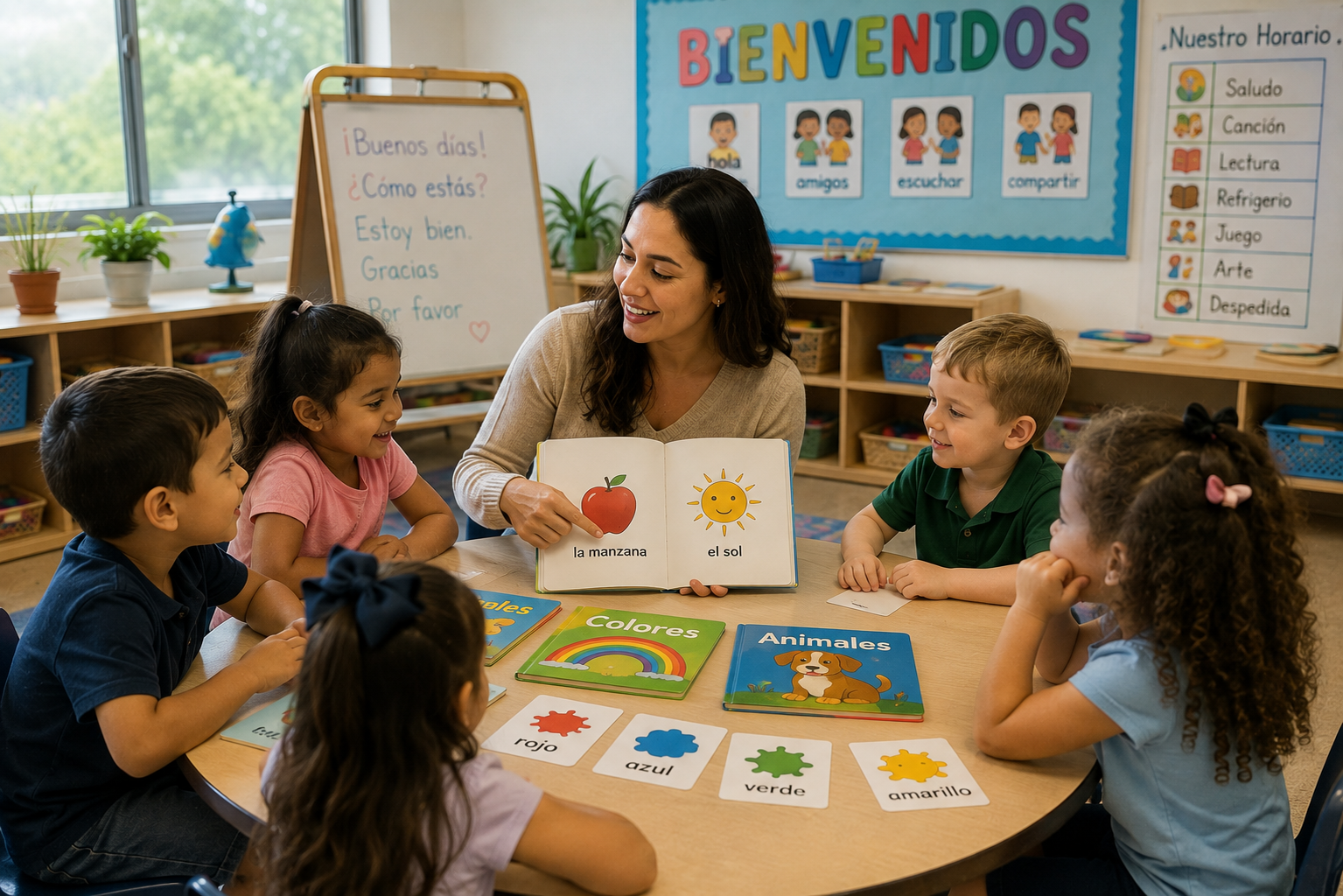
For a young child, it might mean hearing “¡Buenos días!” every morning until the phrase becomes familiar.
It might mean singing the same Spanish song repeatedly.
It might mean hearing rojo while choosing red paint.
Language becomes connected to real experiences.
So the better question may not be:
“Is my child too young?”
Instead, ask:
“Is the language being introduced in a way that makes sense for my child's age?”
1. Early Exposure Gives Children More Time to Become Familiar With Another Language
One of the simplest advantages of starting early is also one of the most important:
Time.
Imagine two children.
One first encounters Spanish in middle school.
The other has heard Spanish songs, stories, greetings, instructions, and conversations since preschool.
That doesn't guarantee that the second child will automatically become fluent.
But their relationship with the language may begin from a very different place.
Spanish may already sound familiar.
Certain words may already carry meaning.
The child may already understand that different languages can communicate the same idea.
Research continues to demonstrate that language exposure is an important variable in bilingual development. A recent study following Spanish-English bilingual children found that exposure at home and school predicted different areas of children's later Spanish performance.
Another 2025 study following bilingual children from kindergarten through second grade found that the primary language used for academic instruction was associated with different patterns of Spanish and English development. Children instructed primarily in Spanish showed stronger Spanish skills and better maintenance of those skills over time.
For parents, the practical lesson is straightforward:
Exposure matters, and continued opportunities to experience a language matter too.
A few Spanish words once in a while aren't the same as regular, meaningful interaction with the language.
2. Young Children Can Learn Through Context Instead of Translation
Imagine a teacher says “siéntate” to a preschooler who doesn't know the phrase.
If the child only hears the word, they may not understand.
But now imagine the teacher gestures toward the chair, sits down herself, and other children begin sitting.
Suddenly, there are clues.
This is one of the useful features of early childhood environments.
Children aren't learning language in isolation.
They're surrounded by:
- Objects.
- Actions.
- Facial expressions.
- Pictures.
- Other children.
- Repeated routines.
- Music.
- Stories.
- Gestures.
- These provide context.
A child can gradually begin figuring out what language means without needing every Spanish word immediately translated into English.
This can happen naturally during play.
A teacher may say azul while pointing to blue paint.
Count uno, dos, tres while children stack blocks.
Use familiar Spanish words while serving food.
Repeat the same phrase each day during cleanup.
The meaning begins to live inside an experience.
This is one reason Kids Language Academy's Spanish immersion approach can fit naturally into early childhood.
Children can experience Spanish while they're already doing the things young children do:
Playing, singing, creating, moving, listening, exploring, and interacting.
3. Children Begin Understanding That Communication Can Happen in Different Ways
Here's something fascinating about second language learning for toddlers and preschoolers:
Children begin discovering that one idea doesn't always have one word.
A dog can also be perro.
A house can be casa.
A book can be libro.
Blue can be azul.
The object hasn't changed.
The language has.
Children experiencing more than one language may start noticing differences in sounds, words, patterns, and expressions.
And sometimes they'll mix them.
A preschooler may begin a sentence in English and insert a Spanish word.
Another may answer in English after a teacher asks something in Spanish.
Parents sometimes worry:
“Is my child confused?”
Language mixing by itself isn't evidence that a child is confused.
Bilingual children's abilities can also be distributed differently across their languages because they don't necessarily experience both languages in the same places or for the same purposes.
For example, a child may know lots of family-related vocabulary in the language used at home but more classroom vocabulary in the language used at preschool.
Research increasingly emphasizes the importance of considering a bilingual child's whole language experience. A 2026 ASHA study involving bilingual preschoolers found that parent reports of children's English exposure and proficiency predicted performance on several standardized language measures, reinforcing the value of understanding the child's actual language environment.
That's useful for parents because bilingual development doesn't always look exactly like monolingual development duplicated twice.
4. Early Language Learning Can Strengthen Listening and Communication Experiences
Children learning another language spend a lot of time listening.
They hear something unfamiliar and begin searching for clues.
- What is the teacher pointing to?
- What are the other children doing?
- Have I heard that phrase before?
- Does the teacher use it every day before lunch?
This doesn't mean bilingualism automatically gives every child superior attention or memory. Claims about universal cognitive advantages should be treated carefully.
But there is something practical happening:
The child is gaining experience communicating across more than one language.
They learn that understanding isn't always immediate.
They may need to listen.
Watch.
Wait.
Use context.
Try a word.
Listen again.
For a preschooler, that's a valuable communication experience in itself.
Research involving bilingual preschoolers also shows how detailed this learning can become. A study of Spanish-English bilingual children ages 3½ to 5½ examined how language exposure influenced children's perception of specific English vowel contrasts, illustrating that bilingual language development includes learning subtle sound patterns and that the amount and diversity of input can matter.
Parents don't need to understand phonetics to appreciate the larger lesson:
Children's brains are paying attention to much more about language than vocabulary alone.
5. Another Language Can Introduce Children to Different Cultures
Spanish isn't simply English with different words.
Language belongs to people and communities.
Spanish is spoken across many countries and regions, with enormous diversity in:
- Music.
- Food.
- Stories.
- Traditions.
- Art.
- Celebrations.
- History.
- Accents.
- Expressions.
- Family traditions.
A thoughtful Spanish immersion for kids program can introduce some of this cultural richness in age-appropriate ways.
Children might hear music from a Spanish-speaking country.
Read a story featuring a different community.
Explore an art tradition.
Learn where Spanish-speaking countries are located.
Talk about foods.
Hear different ways Spanish can sound.
None of this needs to become a complicated geography lesson for a three-year-old.
The message can be simple:
“People around the world speak different languages and live in different ways.”
And:
“Those differences are interesting and worth learning about.”
NAEYC's guidance for supporting dual language learners emphasizes practices that nurture children's bilingual identities while recognizing the importance of family and home language in the educational process.
Language learning can therefore be about more than what children can say.
It can help expand what they know about the people around them.
6. Early Exposure Can Make Another Language Feel Like a Normal Part of Everyday Life
Imagine that Spanish only appears in a child's life during a formal lesson once a week.
Now compare that with Spanish appearing during:
Morning greetings.
Songs.
Stories.
Play.
Art.
Counting.
Meals.
Transitions.
Outdoor activities.
Conversations.
In the second environment, Spanish isn't an unusual event.
It's part of the day.
This is an important distinction when parents evaluate a Spanish immersion preschool in Oviedo.
Ask:
“How often will my child actually experience Spanish?”
And:
“What will my child be doing while hearing Spanish?”
The second question is especially useful.
If the answer involves play, stories, conversation, movement, music, and classroom routines, the language has meaningful context.
NAEYC's resources on dual language learners emphasize intentional and developmentally appropriate practices, rather than treating additional-language development as a disconnected academic exercise.
At Kids Language Academy, the goal of immersion isn't to make a preschooler feel like they're attending an adult language course.
Spanish can become another part of a rich early-learning environment.
7. Learning Another Language Can Create More Opportunities for Connection
At its heart, language exists because people communicate.
That's why one of the most meaningful benefits of bilingual education for children may be connection.
For some families, Spanish connects children with grandparents or relatives.
For others, it may help children communicate with classmates, neighbors, teachers, or community members.
For a family without Spanish-speaking relatives, another language can still widen the child's understanding of communication.
You may notice your child recognize Spanish somewhere outside preschool.
Maybe they hear a song and know a word.
Notice Spanish on a sign.
Understand a greeting.
Recognize a number.
Teach you something they learned.
Those moments matter because the language suddenly has a life beyond the classroom.
A Small Parent Challenge
The next time your child uses a Spanish word, don't immediately test them with:
“What does that mean?”
Try:
“That's interesting. Where did you hear that?”
You may get a much richer conversation.
Will Learning Two Languages Confuse My Child?
This deserves its own section because the concern is so common.
Experiencing two languages doesn't mean children need to keep them perfectly separated at all times.
Young bilingual children may:
- Use words from both languages.
- Respond in one language after hearing another.
- Understand more than they can say.
- Know certain concepts in one language first.
- Prefer one language in certain situations.
These patterns need to be understood within the child's broader language experience.
NAEYC specifically provides resources for children learning a second language while continuing their home language, and its professional guidance treats children's bilingual identities and home languages as assets.
If parents have concerns about their child's speech or language development, those concerns deserve professional attention.
But simply hearing or using two languages isn't, by itself, evidence of a language problem.
Should We Stop Speaking Our Home Language?
No. Families shouldn't feel they need to replace the language they use most naturally at home just because their child is learning another language.
Your home language lets you:
- Tell detailed stories.
- Explain complicated ideas.
- Share humor.
- Discuss emotions.
- Teach family history.
- Comfort your child.
- Build relationships.
- Those interactions are valuable.
NAEYC notes that children need consistent exposure to their languages and that supporting the home language helps sustain connections with family and culture.
Recent research adds another useful point. In the 2025 study of 164 Spanish-English bilingual children mentioned earlier, children with higher Spanish exposure at home showed stronger gains in Spanish measures, while researchers found no significant negative effect on changes in English standard scores across exposure groups.
So if your family communicates most naturally in English, Portuguese, Spanish, Creole, or another language, continue having rich conversations in that language.
Spanish immersion can add to a child's language experiences rather than forcing another language out.
What If We Don't Speak Spanish at Home?
That's okay too.
You don't need to become your child's Spanish teacher.
Instead, become interested in what they're discovering.
Try these simple ideas:
- Let your child teach you.
Ask for a new Spanish word or song. - Listen together.
Find age-appropriate Spanish music. - Read bilingual books.
Picture books provide helpful context even when parents aren't fluent. - Use simple routines.
Practice a greeting or count toys together. - Celebrate attempts.
Don't make perfect pronunciation the goal. - Ask the school what they're learning.
If you know the songs, themes, or vocabulary children are experiencing, you can show interest at home.
Most importantly:
- Keep it enjoyable.
You don't want a child thinking every Spanish word they use will lead to a quiz.
- Does Bilingualism Automatically Make Children “Smarter”?
This is where good parent education needs to be careful.
You may see articles promising that bilingual children automatically have:
- Better memory.
- Superior attention.
- Higher intelligence.
- Better problem-solving.
- Greater executive function.
Research into these areas is complex, and not every proposed “bilingual advantage” appears consistently across every study or every child.
That's why Kids Language Academy doesn't need exaggerated claims to explain the value of Spanish immersion.
The meaningful benefits are already substantial.
Children can:
- Develop experience with another language.
- Become familiar with different sounds and expressions.
- Learn that communication can happen in multiple ways.
- Encounter different cultures.
- Connect with more people.
- Build a language foundation they can continue developing.
Those are worthwhile bilingual children benefits without promising that Spanish automatically changes a child's IQ.
What Should Oviedo Parents Look for in an Early Language Program?
If you're exploring a bilingual preschool in Oviedo, FL, ask questions that reveal what language learning actually looks like.
Try:
- How much Spanish will my child hear?
- Is Spanish part of everyday routines or mainly a separate lesson?
- How do you support children who are completely new to Spanish?
- Do children have time to listen before they're expected to speak?
- How is Spanish incorporated into play?
- How are stories, songs, and conversations used?
- How do you introduce Spanish-speaking cultures?
- How do you communicate children's language experiences to families?
Then evaluate everything else too.
A good immersion program still needs:
- Caring teachers.
- Safe classrooms.
- Play.
- Movement.
- Friendships.
- Communication.
- Age-appropriate learning.
- Healthy routines.
- Opportunities for creativity.
Language should enrich the early-childhood experience not replace it.
Early Language Learning at Kids Language Academy
For Oviedo families interested in introducing another language during the early years, Kids Language Academy offers a Spanish Immersion Program (SIP) within a warm, family-owned learning environment.
Children can encounter Spanish naturally through everyday experiences such as songs, stories, classroom routines, conversations, and play.
KLA serves infants, toddlers, preschool and Pre-K children, as well as school-aged children.
Families also benefit from fresh homemade meals, School Readiness acceptance, low staff turnover, and extended weekday hours from 6:45 AM to 6:30 PM.
But Spanish immersion isn't about rushing children toward fluency.
It's about creating opportunities.
Give Your Child Time to Discover Another Language
So, is your child too young to experience another language?
Early childhood can be a valuable time to begin not because children need formal language lessons as early as possible, but because language can become part of the experiences they're already having.
A song.
A story.
A conversation.
A greeting.
A game.
A color during painting.
Counting during block play.
A teacher patiently repeating a familiar phrase.
These moments can seem small.
But language development is built through experiences.
Research continues to reinforce that the amount, context, and continuity of children's language exposure matter.
For parents considering Spanish immersion for kids, perhaps the most useful question isn't:
“How quickly will my child become bilingual?”
It's:
“Am I giving my child a meaningful opportunity to experience another language?”
For many families, that's where the journey begins.
Discover Spanish Immersion at Kids Language Academy
If you're an Oviedo parent curious about early bilingual learning, seeing the environment in person can help you decide whether Spanish immersion feels right for your child.
Meet the teachers.
See the classrooms.
Ask how Spanish becomes part of everyday activities.
And discover how language, play, relationships, and early learning can work together.
Kids Language Academy
2751 Tuskawilla Rd, Oviedo, FL 32765
Phone:
(407) 574-2572
Hours:
Monday–Friday, 6:45 AM–6:30 PM
Website:
kidslanguageacademyfl.com
Schedule a visit to Kids Language Academy and discover how Spanish immersion can become a natural part of your child's early-learning experience.